
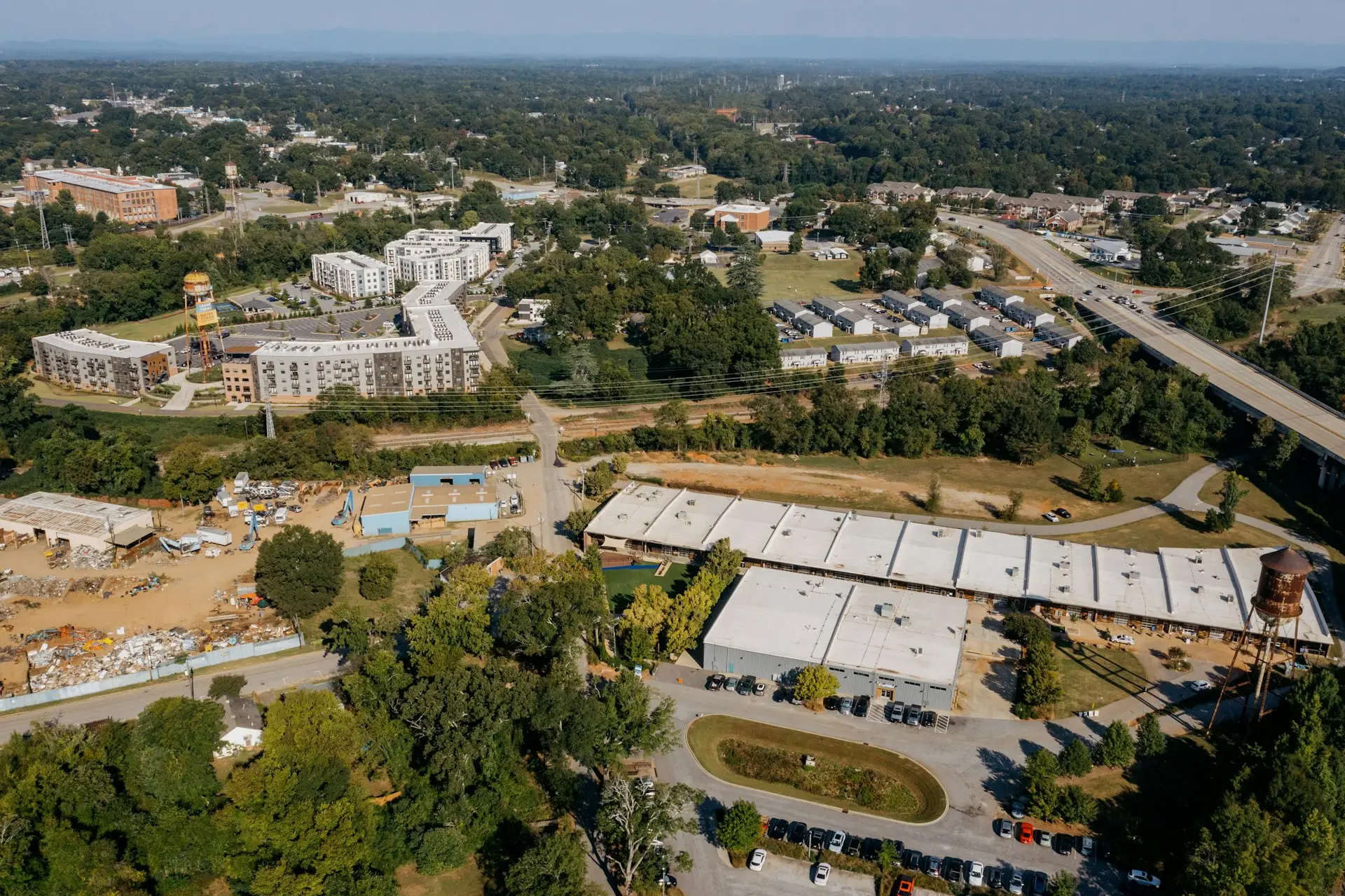
A multi-building complex is one owners association (WEG) with several buildings. The Condominium Act does not expressly define sub-communities; they rest on the declaration of division (§ 10 (1) WEG). The overall association has legal capacity (§ 9a (1) WEG), a sub-community rarely does. Owners may resolve separate cost circles for individual costs or types of cost (§ 16 (2) sentence 2 WEG); the declaration must expressly allow building-level resolutions.
What is a multi-building complex?
A multi-building complex exists where a single owners association comprises several structurally separate buildings. Typical examples are a terrace of houses with a shared underground garage, a quarter of several apartment blocks around a common courtyard, or a complex of a front and a rear building.
The decisive point: in law it is still one association. When the condominium land registers are opened, § 9a (1) WEG creates exactly one owners association, regardless of how many buildings stand on the plot. There are not three associations because there are three buildings, but one association with three buildings.
This creates a practical tension. The owners of one building usually do not want to pay for the repair of a roof that is not even theirs, nor to have a say over the facade colour of someone else’s building. The instrument of the sub-community exists precisely for this.
What are sub-communities?
A sub-community is the internal subdivision of a multi-building complex, usually along the individual buildings. The owners of one building then form a sub-community responsible for their own costs and certain of their own affairs.
Here lies the most important legal point: the WEG does not expressly recognise the term sub-community. There is no statutory definition and no provision that grants a sub-community rights. Sub-communities rest exclusively on the declaration of division and the community rules as an agreement among the owners (§ 10 (1) WEG), together with the case law developed around them. What a sub-community may and may not do is therefore not in the statute but in the specific document of the particular complex.
From this follows a second clarification that cannot be stressed enough.
The legal entity remains the overall association
Full legal capacity under § 9a (1) WEG belongs only to the owners association as a whole. It can acquire rights, incur liabilities, sue and be sued. A sub-community, by contrast, is as a rule not itself a legal entity. It is an internal cost circle and decision area, but not a legal person in its own right.
In practice this means:
- Contracts with tradespeople, utilities or the manager are concluded by the overall association, not by the individual building
- In litigation the overall association is the party. A single building cannot independently sue or be sued as a sub-community
- Externally, under § 9a (4) WEG, each owner is liable for the association’s debts in proportion to their co-ownership share. Belonging to a sub-community does not remove an owner from this overall liability, even where costs are kept separate internally
What the declaration of division can do is therefore not to confer legal capacity, but to order responsibilities, cost circles and voting rights internally. That is a great deal, but it is something other than a separate association. Mixing the two builds disputes into the structure.
Separate cost accounting per building
The most common purpose of a sub-community is separate cost-bearing. The statutory standard under § 16 (2) sentence 1 WEG is the co-ownership share: in principle every owner bears all costs proportionately, including those of the other building. In a multi-building complex that is usually not what anyone wants.
The community rules therefore typically provide for costs to be divided into separate cost circles. The legal basis is the agreement of the owners (§ 10 (1) WEG) combined with the freedom to deviate from § 16 (2) WEG. Under § 16 (2) sentence 2 WEG owners may also resolve a deviating allocation for individual costs or types of cost.
| Type of cost | Typical assignment |
|---|---|
| Roof, facade, stairwell of one building | sub-community of that building |
| Heating per building (own plant) | the respective sub-community |
| Outdoor areas, access roads, shared garage | overall association |
| Manager’s fee, insurance of the complex | usually overall association, partly pro rata |
| Maintenance reserve | often formed separately per sub-community |
Example: A complex consists of building A and building B with separate heating systems. The community rules provide that heating, roof and stairwell costs are borne only by the building concerned, while the garage, outdoor areas and manager’s fee are borne by all by co-ownership share. If the roof of building B must be renewed, the owners of building B alone pay for it. The owners of building A are not charged, even though they belong to the same association.
Formally it nevertheless remains one annual statement. Within the overall statement under § 28 WEG the manager shows separate cost circles per building. Under § 28 (1) WEG the owners resolve on the advances, and under § 28 (2) WEG on the collection of additional contributions or the adjustment of the resolved advances; the annual budget and the annual statement are only the basis that the manager prepares for those resolutions (§ 28 (1) sentence 2 and (2) sentence 2 WEG). With a clean separation these resolutions can be framed so that each building votes only on its own cost circles, insofar as the community rules provide for it.
Own resolutions by the sub-communities
Beyond mere cost separation, many community rules allow the individual buildings to decide their own affairs themselves. This too is not a matter of course in law but must be expressly laid down in the community rules.
It is permissible, and recognised in case law, to give a sub-community its own decision-making power for building-specific affairs, such as the maintenance of its own building, the choice of tradespeople for its own building, or the use of its own reserve. Only the owners of the building concerned are then entitled to vote, and their votes are counted in a separate resolution.
Two limits matter here:
- Scope: sub-community resolutions may only cover what the community rules assign to the sub-community. Common affairs that concern all buildings remain with the overall association
- Voting rights: who votes when must be set out unambiguously. Otherwise a resolution is voidable, because it remains unclear whether the correct decision-making unit decided
Without an express opening in the community rules, the principle holds: resolutions are passed by the overall association of owners. A sub-community cannot grant itself competences.
Typical conflicts in multi-building complexes
In practice disputes almost always arise over the same points:
- Common or building-specific? Argument over whether a cost item affects all buildings or only one. Example: a central plant located in building A but supplying all buildings
- Voting rights and decision competence: unclear whether the overall association or only one building votes on a measure. Wrongly constituted resolutions are voidable
- Maintenance and reserve: where reserves are kept separately per building, dispute arises as soon as a common measure has to be funded from several pots
- Management of the overall complex: the manager’s fee and shared insurance must be apportioned fairly between the overall association and the sub-communities
Behind all of this usually lies the same cause: an imprecise declaration of division.
Why a clear declaration of division is decisive
Because the statute does not regulate sub-communities, the declaration of division with the community rules is the actual rulebook of the complex. It must answer precisely which costs are common and which are building-specific, which affairs a sub-community may decide itself, and how voting works in such sub-community resolutions.
Under § 10 (3) WEG, agreements bind the legal successor of an owner only if they are entered in the land register as content of the special property. A mere practice or an unregistered resolution does not bind a later buyer. Anyone buying a flat in a multi-building complex should therefore examine the declaration of division carefully. If it is unclear, the statutory standard applies in case of doubt, that is allocation by co-ownership shares through the overall association, and that is often not what the parties expect. An owner can demand an adjustment only under the narrow conditions of § 10 (2) WEG, where adherence to the existing rule appears inequitable for serious reasons.
Multi-building complexes in the Rhine-Main region
In the densely built Rhine-Main region multi-building complexes are common: new-build quarters in Frankfurt-Riedberg or the Europaviertel, perimeter-block developments with a shared underground garage, and infill developments with a front and a rear building almost inevitably bring separate buildings under one land register. It is precisely here that a clean division into sub-communities pays off, because the costs and the maintenance pace of the individual buildings often diverge sharply. An experienced condominium management in Frankfurt separates the cost circles correctly, prepares resolutions for the right decision-making unit and keeps the annual statement clearly separated.
Anyone who wants a multi-building complex managed professionally should look for proven qualification. A certified property management knows the pitfalls of separate cost circles, registered agreements and the correct distribution of voting rights, and thereby prevents exactly the conflicts that most often end up in court in multi-building complexes.
Sources
Editorial responsibility: digo.immo Verwaltung & Invest - certified residential property manager under § 26a WEG (IHK Frankfurt), licence under § 34c GewO. About the certification
This article provides general information only and does not replace individual legal advice. It was created with AI assistance; the legal statements have been checked against the official texts of the law. Legal status: 28/08/2026; laws and case law may change. No warranty is given as to completeness, accuracy or timeliness. When in doubt, please seek qualified advice.